I joined this SEO engagement after the client had migrated from a legacy domain to a new .com domain and moved its website from WordPress to Webflow.
The website wasn’t starting from zero.
It already had 170+ blog posts, existing search visibility and years of accumulated content.
But the migration had left technical debt behind. Some URLs had changed, some content had been removed, and legacy URLs needed redirect and internal-link cleanup.
The content library had its own problems too.
Multiple articles addressed similar subjects, while other pages generated search impressions without producing meaningful organic clicks.
My first instinct wasn’t to publish more content.
I wanted to understand what we already had, what was broken, and which parts of the website were actually worth improving.
That became the foundation of the SEO strategy for the engagement.
The project at a glance
Project: Project Atlas
Client: Confidential B2B SaaS company
Industry: Enterprise software / security technology
Market: Primarily US-focused
Role: SEO strategy and execution
Starting point: Domain + CMS migration, 170+ existing blog posts and accumulated technical/content debt
Primary challenge: Technical cleanup combined with unclear content architecture
Most important outcome: 527% growth in non-branded Google organic clicks
Comparable period: July 2025 → April 2026
Project Atlas is a pseudonym. Client-identifying information has been anonymized or generalized in accordance with confidentiality obligations.
The problem wasn’t just technical SEO
The website had several different problems happening at the same time.
The migration had created technical issues.
The content archive needed restructuring.
Internal linking wasn’t taking users and search engines through the website in a deliberate way.
Some commercial pages were underdeveloped.
And, as AI-generated search became more relevant, we also needed a way to understand how the brand was appearing in those environments.
I decided to treat these as parts of the same organic search system rather than separate SEO projects.
The basic idea was:
Fix the foundation, make the existing content work harder, then scale what proves valuable.
1. I started with the technical debt
I began with a detailed technical SEO audit and converted the findings into a prioritized implementation roadmap.
I categorized issues into:
- Must Resolve
- Good to Resolve
- Ongoing monitoring
This helped separate issues that could directly affect crawling, indexation and search visibility from lower-priority optimization opportunities.
Some of the findings included:
- 59 pages with non-sequential H2 structures
- 10 internal 404 pages indexed in Google
- 26 duplicate title tags
- 126 occurrences involving legacy-domain URLs and redirect/link cleanup
- Approximately 270 pages with relevant schema opportunities
- Approximately 270 pages with missing image alt text
- Homepage issues involving hidden, irrelevant and placeholder content
- Sitemap and crawl-depth opportunities
- Internal-linking gaps
- Case-study interlinking opportunities
- Outdated years in titles, metadata and content
- 22 integration pages with insufficient content
- Large-scale blog content and UX issues
The audit therefore became more than a list of errors.
It became the foundation for deciding where SEO effort should go.
An SEO problem that wasn’t really an SEO problem
During the engagement, the site’s server load suddenly increased.
Because the website was on Webflow, we didn’t have direct access to the server logs.
So we asked Webflow to provide the logs and analyzed the crawl activity.
The analysis showed repeated crawling from irrelevant automated and scripting-based bots, including Python-based crawlers and other bots that weren’t useful for the business.
The problem wasn’t that Google or Bing were suddenly crawling too much.
We had unwanted automated traffic consuming resources.
We strengthened the site’s security and bot controls through Cloudflare and robots.txt, while preserving access for legitimate search-engine crawlers.
This was a useful reminder that SEO sometimes takes you outside the traditional SEO toolkit.
The first question wasn’t:
“What SEO setting should we change?”
It was:
“What is actually causing the problem?”
2. Cleaning up the migration
The domain and CMS migration left behind a number of legacy URL and redirect issues.
The audit identified 126 occurrences involving legacy-domain URLs, redirects and internal references.
I reviewed these as part of a broader migration cleanup rather than treating redirects as isolated technical tasks.
The basic relationship I wanted to establish was:
Legacy URL → Relevant current URL → Correct internal link → Consistent destination
A redirect working technically doesn’t necessarily mean that a migration is clean from an SEO perspective.
If an old page redirected to an irrelevant destination, the technical status might look fine while the underlying search intent relationship was broken.
So the cleanup considered both technical correctness and content relevance.
3. Working around Webflow’s sitemap limitations
One of the more interesting technical challenges came from Webflow’s native XML sitemap.
At the time, the sitemap didn’t provide lastmod dates in the way I wanted for the site’s indexing workflow. This was particularly relevant because the target audience still included users who preferred Bing, and Bing’s ecosystem also mattered for our broader AI-search visibility work.
Rather than changing the CMS, I used Cloudflare as a reverse proxy to create a custom XML sitemap with automatically updated lastmod dates.
The sitemap pulled modification data from Webflow’s backend and dynamically updated when content changed.
I also configured Bing’s IndexNow API to automate URL submission when new content was published.
I documented the technical implementation separately in:
Using Cloudflare to Improve Sitemap Functionality on a Webflow Site
The important part of the case study is the reasoning:
Webflow had a limitation → the limitation affected the workflow → I looked for a layer outside the CMS that could solve it → Cloudflare became that layer.
4. I stopped treating 170+ blog posts as 170+ opportunities
The website already had a substantial content library.
There were more than 170 existing blog posts, but the archive didn’t have clear keyword ownership across every page.
Multiple articles addressed similar subjects, while other articles were generating impressions without meaningful clicks.
Rather than immediately creating more content, I reviewed approximately 173 existing blog posts.
For each page, I looked at things such as:
- Core keyword
- Search intent
- Organic performance
- Content overlap
- Underperforming pages
- Rewrite opportunities
- Consolidation opportunities
- Internal-linking opportunities
The central question was:
Which page should own which search topic?
That became the foundation of the content strategy.
5. Content consolidation instead of content inflation
One of the biggest opportunities was reducing unnecessary overlap in the existing content library.
Multiple articles addressed similar subjects, creating situations where several URLs could potentially compete for related search demand.
I didn’t automatically assume that every article needed to remain a separate page.
For each situation, an existing page could be:
- Retained
- Updated
- Rewritten
- Consolidated
- Redirected
- Repositioned around a different search intent
The goal was to create clearer ownership of important topics.
This changed the content question from:
“How much content can we publish?”
to:
“Do we have the right page targeting the right search intent?”
For a mature B2B SaaS website, I found that distinction much more useful.
6. Building a keyword strategy around the buyer journey
Alongside the content audit, I developed a broader keyword framework covering approximately 270 keyword records.
The research incorporated:
- Primary keywords
- Secondary keywords
- Search volume
- Keyword difficulty
- CPC
- SERP observations
- Existing URL mapping
- Business relevance
I also used competitor research to identify areas where the website could expand its organic footprint.
But I didn’t treat every keyword as an independent traffic opportunity.
The strategy considered different stages of the buyer journey:
- Informational searches
- Problem-based searches
- Use cases
- Industry searches
- Product and feature searches
- Evaluation and comparison searches
- Commercial intent
This helped connect keyword research with the actual structure of the website.
7. I started using customer conversations as an SEO input
Traditional keyword research gave us a useful baseline.
But SEO tools have an obvious limitation: they can only tell you so much about topics that people search for often enough to be measured.
Sales conversations gave us another source of information.
I analyzed sales-call and CRM data to identify recurring customer problems, feature expectations, industry-specific workflows and niche use cases that weren’t always visible in traditional SEO tools.
I used these insights to:
- Identify content gaps
- Improve existing pages around real customer language
- Uncover use cases that warranted dedicated content
- Validate whether our SEO targeting was attracting the right ICP
- Identify topics worth covering even when traditional tools showed little or no search volume
I documented this process separately in:
Using Sales Call Data for SaaS SEO
This changed the content strategy from being purely keyword-led to customer-led.
8. I didn’t ignore topics just because they had zero search volume
Sales conversations also surfaced topics and use cases that had little or no measurable search volume.
The easy thing to do would have been to discard them.
Instead, I evaluated them based on:
Customer relevance + buying intent + business value
Some of these insights were used to strengthen existing pages.
Others informed dedicated use-case or industry content.
This was an important shift in how I thought about B2B SaaS SEO.
Search volume is useful.
But it isn’t always a proxy for business value.
A topic that has 0 measurable monthly searches but repeatedly comes up in conversations with qualified prospects can still be worth covering.
9. Turning keywords into content architecture
The keyword strategy then had to become something more useful than a spreadsheet.
I translated it into topic clusters and relationships between core pages and supporting content.
The intended architecture was:
Core topic → Supporting topic → Informational content → Relevant commercial page
This gave the blog a more deliberate role within the wider website.
Instead of treating blog posts as isolated traffic destinations, the content was designed to support broader topical relationships and help users move toward relevant solution and commercial pages.
10. Internal linking became an information-architecture problem
The internal-linking audit identified 600+ opportunities to add contextual internal links and approximately 34 existing links that needed updating.
The work covered:
- Blog-to-core-page links
- Case-study interlinking
- Contextual anchor text
- Core-page relationships
- Supporting content
- Related posts
- Commercial-page links
But I didn’t want to approach this as:
“We need to add 600 internal links.”
The more useful question was:
“Which pages should be connected, and why?”
For example:
Informational article → Relevant use case → Solution page → Commercial action
This made internal linking part of the website’s information architecture rather than simply another SEO checklist.
11. Making the blog more useful after someone lands on it
Approximately 157 blog posts were reviewed for on-page content and UX improvements.
The audit covered areas such as:
- Heading structure
- Tables
- Summaries
- Internal links
- CTA placement
- “Read more” links
- Content formatting
- Navigation
- Author information
- Updated dates
- Breadcrumbs
The purpose wasn’t to make every article longer.
It was to make the content more useful once someone arrived from search.
Organic traffic is only valuable if the landing page can answer the user’s question and guide them toward the next relevant piece of information.
12. Turning underdeveloped integration pages into useful search assets
The audit identified 22 integration pages with insufficient content.
These pages already existed, but they weren’t doing enough.
I evaluated them as potential long-tail search landing pages rather than treating them purely as product assets.
The objective was to provide useful information around:
- What the integration does
- Who it is for
- What problem it solves
- How it works
- Why the integration matters
- What the user should do next
This helped make the integration pages more meaningful components of the site’s content architecture.
13. Connecting informational search with commercial pages
The SEO strategy also covered important non-blog pages.
Core and solution pages were reviewed for:
- Keyword targeting
- Search intent
- Content depth
- FAQs
- Structured data
- Internal linking
- Supporting content
- Related posts
- CTAs
The objective was to connect informational search demand with pages closer to commercial intent.
The intended path became:
Discovery → Education → Evaluation → Commercial consideration
rather than allowing organic traffic to remain concentrated in informational blog content.
14. Structured data was part of the foundation, not the strategy
The audit identified relevant schema opportunities across approximately 270 pages.
Rather than applying one generic schema implementation everywhere, I approached structured data according to page type.
Recommendations covered relevant areas such as:
- Article
- Organization
- WebPage
- Breadcrumb
- Service
- FAQ
- Other appropriate page-specific structured data
The objective was to make the site’s entities, content types and page relationships easier for search engines to understand.
I didn’t treat schema as a magic ranking lever.
It was one piece of making the website more machine-readable.
15. Then AI search became another discovery surface
During the engagement, AI-generated search experiences became increasingly relevant to how people research products and solutions.
Rather than treating AEO/GEO as a collection of speculative tactics, I wanted to establish a practical measurement framework.
The questions were:
When a potential buyer asks an AI system a relevant question, does the client appear in the answer?
Which competitors appear alongside it?
Which websites are being cited?
Is the client’s website one of those sources?
The work included:
- AEO-oriented content guidelines
- Structured data
- AI-search prompt research
- LLM visibility monitoring
- Source and citation analysis
- Brand visibility tracking
- AI-search competitor analysis
llms.txt
For llms.txt, my view was fairly simple: it didn’t have a demonstrated impact on AI visibility, but the implementation took less than 15 minutes, so I didn’t see much downside in creating it.
16. Measuring LLM visibility
I developed and tracked relevant prompts across topics and audiences and used dedicated datasets to monitor AI visibility.
The project included:
- Hundreds of prompt and visibility records
- More than 1,000 source-URL records in the AI-search dataset
- Brand mentions
- Competitors mentioned
- Position
- Sentiment
- Source URLs
- Market/location
- Topic/service
I used GA4 regex-based LLM tracking with a custom Explore report, Microsoft Clarity, and experimented with prompt-tracking tools including Gumshoe, Otterly, Peec AI and HubSpot’s AI visibility tool.
These tools aren’t perfect.
The prompts are generated based on buyer personas and assumptions about what users might ask, so I don’t consider them a perfect representation of real-world AI-search behavior.
But they were still useful for answering questions such as:
- How are competitors performing across different LLMs?
- How quickly do citations change?
- Which websites are repeatedly being cited?
- Where are competitors receiving text mentions?
- Which profiles and third-party sources appear to matter?
That gave us a baseline for an emerging search surface instead of relying purely on anecdotal observations.
What happened
The clearest comparable period in the project data was July 2025 versus April 2026.
The changes were significant across Google Search Console, Bing Webmaster Tools, Ahrefs and lead progression.
Google Search Console
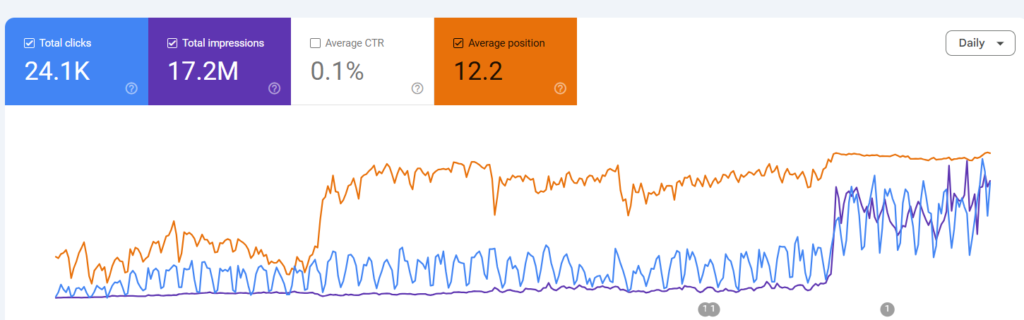
| Metric | Jul’25 | Apr’26 | Change |
|---|---|---|---|
| Total clicks | 1,292 | 4,823 | +273% |
| Non-branded clicks | 651 | 4,086 | +527% |
| Branded clicks | 641 | 737 | +15% |
| US clicks | 580 | 984 | +70% |
| Impressions | 259,859 | 6,535,439 | +2,415% |
| Homepage clicks | 776 | 473 | -39% |
| Blog clicks | 292 | 3,911 | +1,239% |
| Search queries | 8,686 | 25,001 | +188% |
| Indexed pages | 246 | 346 | +41% |
The most striking change was the expansion in non-branded search.
Non-branded clicks increased from:
651 → 4,086
That’s approximately 527% growth.
Total organic clicks increased from:
1,292 → 4,823
That’s approximately 273% growth.
At the same time, branded clicks increased only modestly:
641 → 737
or approximately 15%.
This meant the growth wasn’t simply coming from more people searching specifically for the company.
A much larger share of the growth came from non-branded discovery.
The biggest change was the blog
Blog-folder clicks increased from:
292 → 3,911
That’s approximately 1,239% growth.
This is particularly relevant because a significant part of the strategy was focused on making the existing content library more effective rather than simply increasing the number of URLs.
The work included:
- Keyword mapping
- Content consolidation
- Rewrites
- On-page improvements
- Internal linking
- Topic clustering
- New content opportunities
- Customer-led content research
The blog became a substantially larger discovery channel during the period.
Search visibility expanded dramatically
Organic impressions increased from:
259,859 → 6,535,439
That’s approximately 2,415% growth.
The number of search queries generating visibility increased from:
8,686 → 25,001
or approximately 188% growth.
Again, I don’t treat impression growth alone as proof of SEO success.
The more useful combination was:
More queries → More impressions → More non-branded clicks → More blog-driven traffic
The site was appearing for a substantially broader set of searches than it had at the beginning of the comparison period.
US organic visibility also grew
Because the business was primarily focused on the US market, I also tracked US-specific performance.
Google Search Console clicks from the USA increased from:
580 → 984
That’s approximately 70% growth.
Ahrefs also showed a significant change in US keyword rankings.
| US keyword position | Jul’25 | Apr’26 |
|---|---|---|
| Positions 1–3 | 9 | 125 |
| Positions 4–10 | 9 | 458 |
| Positions 11–20 | 51 | 158 |
The number of US keywords in positions 1–10 therefore increased from 18 to 583.
That’s one of the clearest indicators that the growth wasn’t simply coming from lower-ranking long-tail visibility.
The site developed a much larger footprint across higher-ranking US keywords.
Ahrefs also showed a larger organic footprint
Ahrefs showed:
Organic keywords in the US
637 → 753
Referring domains
273 → 874
The increase in referring domains was approximately 220%.
The organic keyword count increased more modestly, but the distribution of those keywords changed considerably.
The movement from:
9 → 125 keywords in positions 1–3
and:
9 → 458 keywords in positions 4–10
was particularly notable.
Bing became another measurable search channel
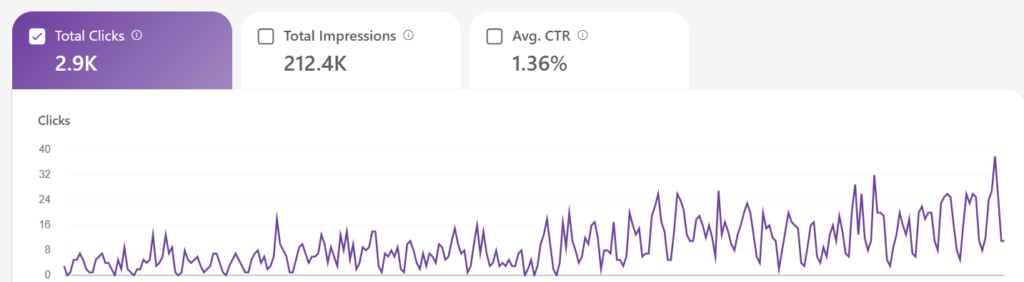
The website was not submitted or indexed on Bing before July 2025, so I wouldn’t present the Bing numbers as percentage growth.
By April 2026, the site had:
- 550 Bing clicks
- 63,800 impressions
- 506 non-branded clicks
- 44 branded clicks
- 211 US clicks
- 532 search queries
- 460 indexed pages
This provided another source of organic visibility data beyond Google.
It also became useful for the wider AI-search measurement work.
AI citations became measurable at scale
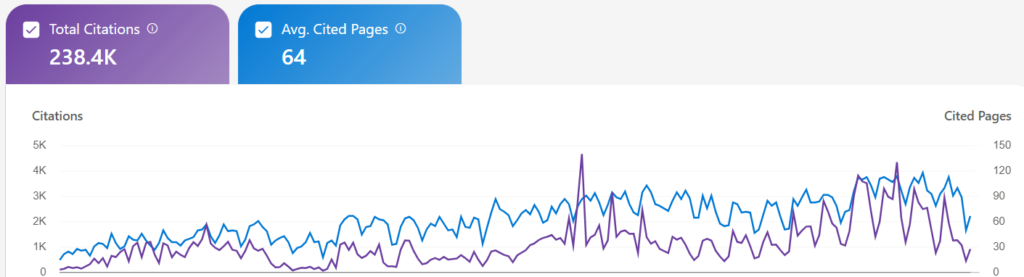
By April 2026, the Bing data also showed:
66,300 total citations
and:
97 average cited pages
I treat these numbers as an indicator of how the website was being surfaced as a source within the AI-search ecosystem rather than as a direct equivalent of traditional organic clicks.
The underlying AI-search environment is also changing rapidly, so I consider this an area where establishing a baseline is more useful than assuming that one metric will remain definitive.
GA4 showed a different picture — and there was an important reason
Some of the GA4 metrics actually declined between July 2025 and April 2026.
For example:
| GA4 User Acquisition | Jul’25 | Apr’26 |
|---|---|---|
| Total users | 5,122 | 1,726 |
| Organic search users | 1,344 | 968 |
| Direct users | 2,443 | 508 |
| Referral users | 919 | 107 |
| Paid users | 111 | 84 |
At first glance, this might look inconsistent with the significant growth visible in Google Search Console.
But there was an important measurement change during the engagement.
We had to introduce and comply with a cookie-consent banner for users in the US and European audience.
As a result, GA4 measurement and attribution were affected.
This is particularly important when comparing GA4 data across the two periods.
I therefore wouldn’t interpret the reduction in GA4 users as equivalent to a corresponding reduction in actual website traffic.
The consent implementation changed how much user activity could be observed and attributed through GA4.
This is also why I prefer using multiple data sources rather than relying on a single analytics platform to judge SEO performance.
Organic engagement metrics also need that context
The GA4 Traffic Acquisition data for organic search showed:
| Metric | Jul’25 | Apr’26 |
|---|---|---|
| Sessions | 2,567 | 1,654 |
| Average engagement time/session | 0.59 | 1.16 |
| Engagement rate | 85.51% | 77.81% |
| Bounce rate | 14.49% | 22.19% |
| Views/session | 3.87 | 2.379 |
| Returning users | 431 | 969 |
The user-consent change is important when interpreting these numbers.
At the same time, some engagement indicators moved in an interesting direction.
Returning users increased from:
431 → 969
while average engagement time per session also increased from 0.59 → 1.16 based on the reported GA4 values.
So I wouldn’t summarize this period as simply “GA4 traffic declined.”
The more accurate interpretation is:
Search Console showed substantial growth in organic discovery, while GA4’s observable traffic and attribution were affected by the introduction of cookie consent.
That distinction matters.
LLM traffic also dipped — largely because measurement changed
LLM traffic showed a similar pattern.
Active users from identified LLM sources were:
50 → 45
And LLM sessions were:
76 → 74
Engaged sessions changed from:
61 → 55
At face value, these numbers represent a small decline.
But, again, the cookie-consent implementation affected what GA4 could observe.
The more interesting metric was session duration:
3.21 → 5:03
based on the reported data.
The LLM traffic dataset also changed in composition:
| LLM | Jul’25 | Apr’26 |
|---|---|---|
| ChatGPT | 29 | 24 |
| Perplexity | 16 | 7 |
| Gemini | 3 | 11 |
| Claude | 0 | 2 |
| Copilot | 1 | 0 |
| Grok | 1 | 0 |
| Other | 0 | 1 |
I wouldn’t use these numbers to claim that AI search traffic itself declined.
The measurement environment changed during the period because of cookie consent banner.
Instead, the data demonstrates why LLM traffic needs to be monitored separately and interpreted alongside consent and analytics implementation changes.
Organic search started showing a clearer business outcome
The most important progression for me was moving beyond traffic metrics.
The available lead data showed:
| Metric | Jul’25 | Apr’26 |
|---|---|---|
| Raw leads — Direct + Organic + LLMs | 28 | 52 |
| MQLs | — | 17 |
| SQLs | 4 | 9 |
| Closing | 2 | 5 |
Raw leads increased from:
28 → 52
That’s approximately 86% growth.
SQLs increased from:
4 → 9
And closed deals increased from:
2 → 5
I wouldn’t claim that SEO alone caused these outcomes because the lead dataset includes direct, organic and LLM traffic.
But the progression provides an important business context for the organic growth.
The SEO program wasn’t operating in isolation from the rest of the acquisition system.
The result I cared about most: non-branded discovery
If I had to choose one SEO metric from this project, it would still be non-branded organic clicks.
They increased from:
651 → 4,086
+527%
This is important because branded searches largely represent people who already know the company.
Non-branded searches represent opportunities to reach people discovering the company through:
- A problem
- A topic
- A use case
- An industry need
- A product category
- A solution
That was the underlying objective of the strategy.
So the most meaningful change wasn’t simply:
1,292 → 4,823 total clicks.
It was:
651 → 4,086 non-branded clicks.
The website was reaching substantially more people who weren’t already searching specifically for the brand.
What made the approach work
1. I treated migration debt as a growth problem
The technical issues weren’t viewed as an isolated audit exercise.
They were constraints on everything else happening on the site.
Cleaning up redirects, indexation, headings, internal links, sitemap workflows and site architecture created a stronger foundation for the content strategy.
2. I optimized the existing content before assuming more content was needed
A website with 170+ blog posts already has a significant amount of historical data and search equity.
Before creating more URLs, I wanted to understand:
- What was already ranking?
- What was generating impressions?
- Which pages overlapped?
- Which pages had no clear keyword?
- Which pages deserved more investment?
That helped shift the strategy from content volume toward content efficiency.
3. I used internal linking to connect search demand to business pages
The 600+ internal-link opportunities weren’t treated as a checklist.
They were used to improve relationships between informational content and the pages closest to commercial intent.
This helped turn the website into a connected content system rather than a collection of individual pages.
4. I used customer data alongside keyword data
Keyword tools are useful, but they don’t represent every problem customers care about.
Sales conversations gave us another way to understand:
What problems are prospects actually trying to solve?
That helped identify topics that traditional keyword research might have ignored.
5. I measured discovery rather than just rankings
Rankings are useful, but they don’t tell the whole story.
I paid particular attention to non-branded clicks because they provide a clearer indication of whether the website is reaching people who weren’t already searching specifically for the company.
That became one of the most useful indicators of progress.
6. I used multiple data sources instead of trusting one dashboard
This project also reinforced something I’ve learned over time:
No single analytics platform tells the whole SEO story.
Google Search Console showed substantial growth in search discovery.
Bing provided another view of organic and AI-related visibility.
Ahrefs provided a third-party view of keyword rankings and referring domains.
GA4 helped with acquisition, engagement and lead analysis, but its measurement was affected by the introduction of cookie consent.
Looking at these sources together produced a more useful picture than relying on any single number.
7. I treated AI search as a measurement problem
Rather than pretending there was already a fixed GEO playbook, I wanted to understand what was actually happening.
Which prompts matter?
Does the brand appear?
Which competitors appear?
Which sources are cited?
Is visibility changing over time?
That framework can evolve as AI search evolves.
What the project taught me
Technical SEO is not just maintenance
When technical problems exist across hundreds of URLs, they can become a genuine growth constraint.
Fixing them creates the conditions for other SEO investments to work more effectively.
Content consolidation can be more valuable than content production
The presence of 170+ articles didn’t automatically mean the site needed more articles.
Sometimes the biggest content opportunity is deciding:
Which pages should exist, which should rank, and which should support each other?
Internal linking is an architectural decision
The best internal links communicate relationships between topics and pages.
They help users navigate the site and help search engines understand how the content fits together.
Search volume isn’t the same as business value
Some of the most useful content opportunities came from customer conversations rather than keyword tools.
A topic doesn’t necessarily need significant measurable search volume to be useful if it represents a real customer problem and has meaningful buying intent.
Non-branded search is a powerful SEO KPI
For B2B SaaS, organic growth is more meaningful when it creates new discovery rather than simply capturing more existing brand demand.
That’s why the +527% increase in non-branded clicks mattered more to me than the overall +273% increase in organic clicks.
Analytics implementation can change the story
The GA4 numbers were affected by the introduction of cookie consent for US and European audiences.
That experience reinforced an important lesson:
A change in measured traffic isn’t always a change in actual traffic.
Analytics data needs to be interpreted in the context of how the measurement system works.
AI search needs to be measured, not just discussed
The SEO industry is still figuring out exactly how AI-generated search will evolve.
Rather than pretending there is a fixed playbook, I found it more useful to establish a measurable baseline around prompts, mentions, citations and sources.
My role
My role covered the SEO strategy and execution layer across the engagement.
I was responsible for areas including:
- Client communication and reporting
- KPI tracking
- Technical SEO auditing and prioritization
- Keyword research and mapping
- Existing-content analysis
- Content consolidation strategy
- Content planning
- Topic clustering
- Internal-linking strategy
- On-page SEO
- Structured-data recommendations
- Indexation and redirect analysis
- SEO implementation coordination
- Google Search Console analysis
- AEO/GEO strategy
- LLM visibility tracking
- Sales call data analysis
- Monthly page level lead data analysis
- Ongoing technical SEO monitoring
Where implementation required development, design or content resources, I worked with the relevant teams to translate SEO recommendations into actionable changes.
Final takeaway
This project wasn’t about finding one technical issue that suddenly transformed organic traffic.
It was about rebuilding the conditions that allow SEO to compound.
The website had inherited technical debt from a migration, a large content archive that needed clearer keyword ownership, hundreds of internal-linking opportunities, underdeveloped commercial pages and an emerging need to understand AI-driven search.
I approached those challenges as one connected system.
Technical SEO created the foundation.
Keyword research established what the site should compete for.
Content consolidation clarified which pages should own those topics.
Customer conversations added another layer of intent beyond search-volume data.
Internal linking connected informational and commercial content.
On-page improvements made important pages more useful.
AEO/GEO introduced a new layer of search visibility measurement.
The resulting data showed substantial expansion in organic search discovery.
Google organic clicks increased by 273%.
Non-branded clicks increased by 527%.
Blog clicks increased by 1,239%.
Organic impressions increased by more than 2,400%.
The site also developed a much larger footprint across higher-ranking US keywords, with keywords in positions 1–10 increasing from 18 to 583 according to the reported Ahrefs data.
The available lead data also showed raw leads increasing from 28 to 52, SQLs from 4 to 9, and closed deals from 2 to 5 across the combined direct, organic and LLM dataset.
I wouldn’t attribute all of those outcomes to SEO alone.
The engagement involved many changes over an extended period, and the lead dataset included multiple acquisition channels.
The bigger lesson for me is the process.
Good SEO is less about collecting isolated tactics and more about understanding how technical infrastructure, content, information architecture, customer intent, analytics and distribution fit together.
That’s the part of SEO I enjoy most.
Not just getting a page to rank.
Figuring out why the system isn’t working, then rebuilding the system.
Confidentiality note: Project Atlas is a pseudonym. Client-identifying information has been anonymized or generalized in accordance with confidentiality obligations. Performance figures shown above represent selected aggregated SEO and acquisition metrics from the engagement; additional business and client-specific information has been omitted.